
While preparing to pack some bags for Belgium the other day, I thought it might be useful to check what weather I’m in for. While the temperatures over there sure beat Buffalo’s freezing feel, I did find something I thought rather shocking.
What was up with Leuven’s air quality?
Before me was a bar firmly in an orange region, marking the quality of the air as “Unhealthy for Sensitive Groups,” which, frankly, I’d never seen before. Knowing I have a sensitive immune system, and having suffered at the hands of allergens in France, I figured I should investigate the matter. What were my lungs getting into?
My search started with a Reddit thread — not the most reputable source, but I thought it might offer some insight into whether the quality was noticeable. Maybe it would suggest some possible causes of the unhealthy air. Some users seconded a concern, posting that the air in Leuven felt heavy, or claimed that there isn’t a strong wind flow in Leuven. There were a variety of simple jokes too: “Sometimes people don’t use deodorant;” “Sorry, had too much onion for lunch;” etc. Funny, sure, and a good sign that I could look forward to Flemish humor, but unhelpful on the air quality front. One user joked about Stella Artois — a famous Belgian beer brand based out of Leuven — writing that they had to increase production in preparation of college students coming back to campuses. This joke had some merit beyond its humor — maybe some concentrated industry was to blame.
What was most useful in the thread, however, was an article offered up on a poor climate report in Leuven. Amidst successful national efforts to reduce CO2 emissions in Belgium, Leuven seemed to lag behind. In fact, progress on reduction seemed inconsistent, slowing from a drop of absolute CO2 emissions of 13.4% to a drop of 12.4% in recent years. In the article, Thomas Van Oppens, a deputy mayor for climate, finance and digitalization, comes to the defense of Leuven. He remarks that it is difficult for the city to make the switch to green energy due to the placement of its airport, which prevents the development of wind turbines. Furthermore, the city’s outdated buildings are poorly insulated — exactly what I want to hear as someone preparing to live there for five months in tight campus quarters — which causes energy usage to increase. Without green energy, this uptick in usage translates to more CO2 emissions, which I thought legitimized the poor air quality report.
While this seemed to be a somewhat satisfactory answer, I still felt as though something was missing. After looking into what air quality reports are based on, I learned about Air Quality Indexes (AQIs). I discovered as well that CO2 itself was not a strong contributor to AQIs, but rather comes into play in that it traps particulate matter (PM), fine particles responsible for adverse health effects such as lung cancer, and the main contributor to high, troublesome AQIs. So while the article I’d encountered offered some explanation, I needed to continue my research.
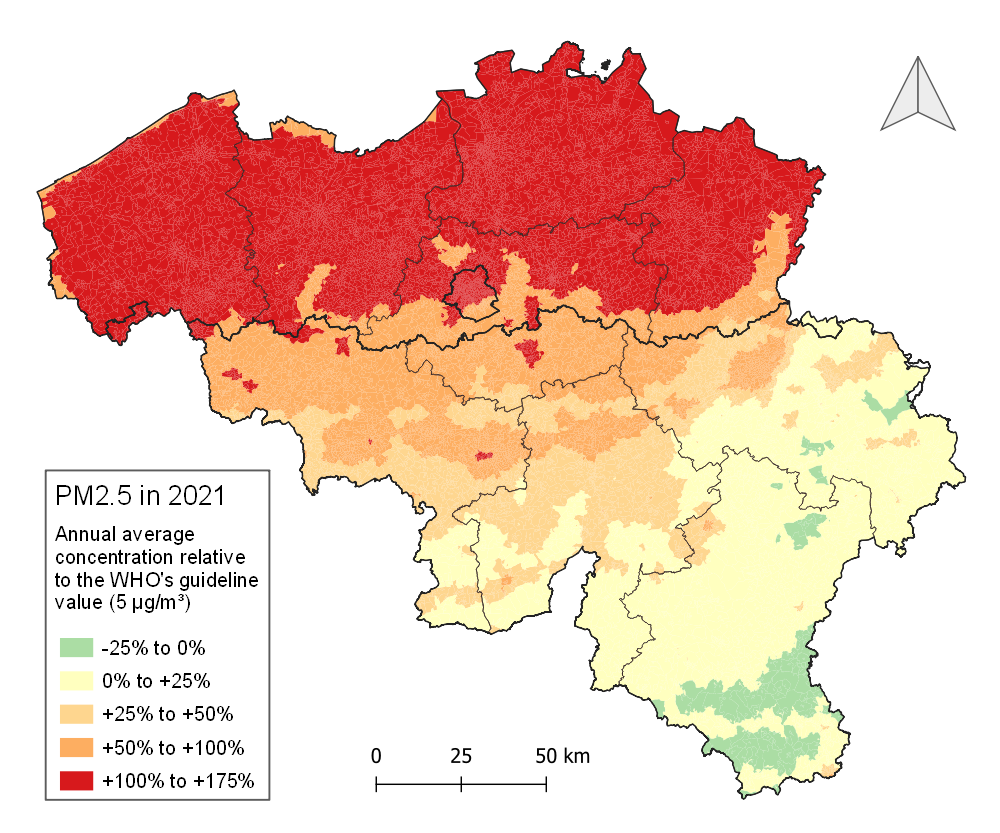
The best source on the matter seemed to be an extensive page on Belgian air quality: “For a healthy Belgium.” When discussing and depicting the Belgium area’s PM concentration, it refers to the World Health Organization’s (WHO) guidelines on what is considered safe to consistently breathe. In harsh red hue (a sure sign of safety), it displays that the Flemish region of Belgium, the northern portion of the nation where Leuven is located, was on average roughly 100-175% over the safe air guidelines only four years ago. Wonderful.
Will I faint? Struggle to breathe? The answer was still up for debate, actually. While AQI is the standard method for calculating air quality, numerous nations determine the final number differently. Belgium updated their BelAQI standards — previously unique to them — in 2022 to fit WHO guidelines better, aligning with other European nations. Even with this modernization, their calculations differ from the United States, as we base our AQI on our Environmental Protection Agency’s guidelines. Whereas U.S.-based groups note Leuven’s air quality as “Unhealthy for Sensitive Groups,” Belgian groups may report it’s only of moderately poor quality. Essentially, what might be rather hazy and heinous in terms of PM concentration at home may just be a typical day in a European city.
Even with differing guidelines, the Belgian health page notes that the Flemish region’s high population density, large industrial complex, and dense agriculture and livestock centers are main contributors to poor air conditions. In the U.S., industries like agriculture have much more space to spread out than in Belgium, a nation the size of Maryland but with almost double the population. Even with sprawling cities like New York, Chicago, and Los Angeles, the U.S. is not as densely packed on average as most European nations. So regardless of calculation differences, the air at home seems simply clearer.
Truthfully, there’s no way for me to tell how the air will compare until I’m on the ground there in Leuven, and there’s many more important things to worry about before takeoff, like packing. Packing which can be conveniently procrastinated by diving into articles on PM2.5, BelAQI, and everything else in the perhaps hazardous Belgian sky…
I’m sure that — after a little adjustment — I can adapt. I’ll just have to take a deep Belgian breath and hope for the best.

Photo Citation
[1] Relative concentration of PM2.5 per statistical sector in Belgium, 2021. “Air quality,” 25 March 2024. For a healthy Belgium, https://www.healthybelgium.be/en/health-status/determinants-of-health/air-quality#def-conc. Accessed 29 January 2026.
 WebbAbroad
Leave a comment