
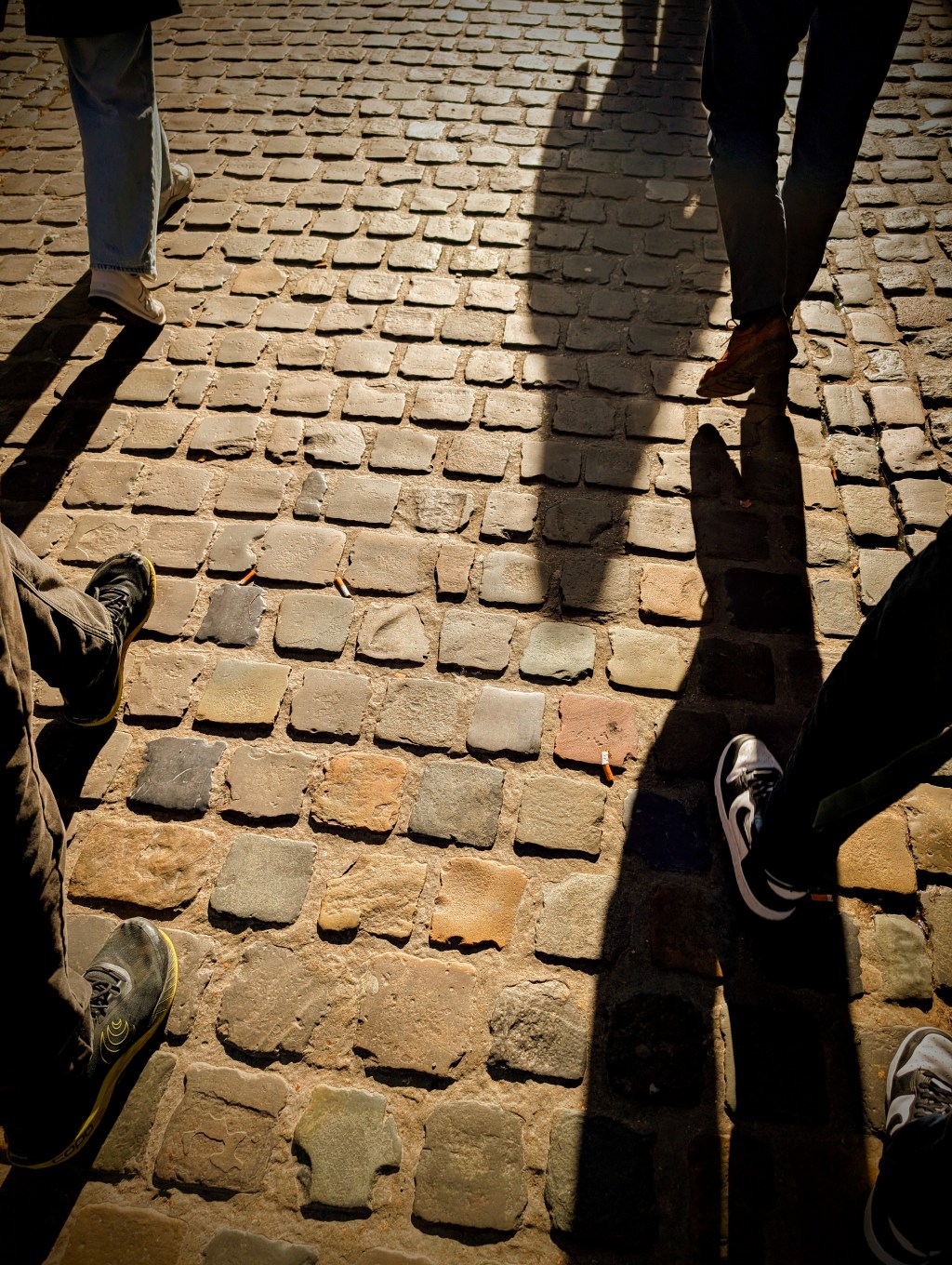
Welcome to Leuven, a city full of walkers, bikers, and… autonomous buses?
After much anticipation, I’ve made my way to Leuven for my study abroad program, and the city has quickly qualified itself as a quaint yet bustling burg. Over the last week, the group of students I’m traveling with has undergone a few dizzying days of orientation including not one, not two, but three separate tours of the cobblestoned city. There’s been a lot of information thrown our way, and while not everything has registered on our exhausted ears, we’ve certainly picked up on the general groove of Leuven.
This “groove” is the steady whir of bicycle tires whizzing by on side streets, and the occasional crackle of car tires on rain-covered roads. It’s rather peaceful and calming. This “groove,” however, is sometimes interrupted by the harsh hiss of bus brakes as they round the city’s tight corners. In fact, on one of the aforementioned tours, our group was almost trampled by one such bus. After several shouts of “BUS, BUS!!” and some swift shuffling of feet, we parted the group in two to make room for the mechanical monstrosity.
The response to this incident was no form of reassurance; instead, a Belgian resident sighed something along the lines of: “Yeah, the buses don’t really stop.” I certainly hope that isn’t the case, especially because some buses may now be driverless. First announced by The Brussels Times in September of 2025, miniature buses drove driverless through the city streets for the first time without a soul onboard. As per the announcement, this effort to progress the technology of De Lijn (pronounced similarly to “the line”), Leuven’s limited loop of buses, has been planned for some time. While certain safety precautions have been taken to minimize potential harm to civilians, I wonder about this so-called advancement in a city with well-established transportation traditions.
Even within the first announcement, some citizens express their concerns. A representative of the General Union of Public Services here in Belgium claimed that the program is not developed enough to actually make an impact as of the end of 2025, and a different union’s representative claims that legislation surrounding the new technology is not properly prepared for the prototype.
POLIS, a network of European cities/regions working towards sustainable travel, outlines how the buses work. A combination of Radar, Lidar, and high-definition cameras help map the layout of Leuven and keep tabs on traffic. They also connect to the city’s grid of traffic lights and other precautionary infrastructure to improve vehicle efficiency and safety. Furthermore, a safety officer is required by EU law to monitor the machine at all times. Interestingly, POLIS’s description of the autonomous bus initiative claims the pilot is set to run until 2027, which conflicts with recent journalism.
Notably, a number of months after the original article announcing the technology, The Brussels Times followed up on the autonomous buses, which, as of January 22nd of 2026, carry real, live Leuvenites. The buses had been developing their artificial intelligence to train for traffic in Leuven’s cramped corridors during the four month stretch between the publishing of the two articles. The update also mentions that autonomous buses will be placed on a separate line — line 16 — which was created specifically for the self-driving shuttles.
As a now resident of Leuven, this seems like an interesting project, to say the least; however, in a city with numerous transport methods, it seems almost an unnecessary risk, regardless of whether passengers can purposefully pick to ride an autonomously piloted bus or not. As noted on my walks to KU Leuven’s campus buildings and on quick trips to grocery stores or cafes, the majority of Leuvenites are haste-hungry bikers who make maneuvers on whims and perhaps prayers. They seem, to me at least, unpredictable, and may require the intuition inherent in humans to properly avoid accidents. Call me cynical, but I don’t trust a computer to handle avoiding a drove of determined college students who strafe the streets without warning.
Just because I happen to worry about the arrival of autonomous buses doesn’t mean everyone does though. For one, my Dutch language professor, an inhabitant of the edges of Leuven, has referred to the project, but didn’t express a particular interest or distaste for it. While several of my classmates took interest in the matter when it was mentioned to us on a tour, it hasn’t been a common topic of discussion. Nobody seems to acknowledge what is one of the most recent and reported changes to the city grid. It seems, interestingly, that the hype surrounding the buses has fizzled out. Maybe it was never truly there to begin with.
Life continues on in Leuven. While new-age technology rapidly approaches, it seems this medieval metropolis swallows it up and continues without concern. Chances are, self-driving shuttles slip by me on my sleep-weary walks to KU Leuven’s crowded campus buildings. They may drive by the bikers furiously pedaling up the city’s steep stone slopes. They may matter to some citizens out there, but the majority of Leuven seems to have accepted their presence without fanfare. Maybe that union representative was right, and the project proved to have little impact.
I have yet to pick up my bus pass, with classes taking up the main portion of my time this last week, but I look forward to potentially welcoming De Lijn online sometime by taking a self-driven ride. Fingers crossed the journey is safe.


 WebbAbroad
Leave a reply to Will Stott Cancel reply